
Halloween at a language school is a thematic lesson that teaches vocabulary, speaking, and the culture of English-speaking countries, while also giving the school a reason to engage with parents and new students.
In 2026, October 31 falls on a Saturday, so it’s advisable to schedule activities for the week of October 26-30. We’ve also gathered 10 ideas with materials, vocabulary for various levels, a ready lesson plan, and ideas on how to utilize this day outside the classroom as well.
What will you find in this article?
- What is Halloween and why does it fit into a language lesson?
- When to have Halloween at a language school in 2026?
- How to use Halloween in learning English?
- 10 ideas for an English lesson on Halloween
- What does a ready-made 45-minute Halloween lesson plan look like?
- How to leverage Halloween in a language school outside the classroom?
- How to talk to parents about the Halloween lesson?
- Summary
Key information
- Halloween is celebrated on October 31st, and in 2026, this date falls on a Saturday.
- Language schools that wish to conduct Halloween activities in 2026 should plan them for the week of October 26th-30th.
- An English lesson on Halloween works best when it combines new vocabulary with a speaking task, rather than just ending with a coloring activity.
- Some parents have reservations about Halloween, so the school should notify them about the themed lesson in advance and have an alternative ready.
- The most common mistake is announcing the themed lesson a day or two before the date, when students might not have time to prepare costumes.
What is Halloween and why does it fit into a language lesson?
Halloween is a holiday celebrated on the night of October 31st to November 1st, most widespread in English-speaking countries. Its name comes from All Hallows’ Eve, which is the eve of All Saints’ Day.
It is believed to have originated from the Celtic festival of Samhain, associated with the end of harvest and the belief that on this night the boundary between the living and the dead becomes blurred. In the 19th century, the tradition made its way to the United States, where it evolved into the form we know today with costumes, pumpkins, and trick-or-treating.
In language schools, Halloween is effective for a simple reason: it provides a ready context. The vocabulary is specific and easy to illustrate, emotions (fear, surprise, laughter) naturally provoke conversation, and Anglo-Saxon culture ceases to be just a chapter in a textbook. Children know most of the symbols from movies and games, and adults enjoy discussing superstitions and horror stories.
There’s also another aspect that’s rarely mentioned. A themed lesson is a break from the textbook routine for the student, and an opportunity for the school to showcase something externally. Photos from classes in costumes, drawings of pumpkins with English captions, or short role-play recordings can be used as social media content that doesn’t need to be invented.
When to hold Halloween in a language school in 2026?
In 2026, October 31st falls on a Saturday, and November 1st on a Sunday. If you conduct classes only on weekdays, there won’t be a lesson on the holiday itself. The last day of classes before Halloween is Friday, October 30th. You have two sensible options.
- First: Friday, October 30th, when Friday groups receive a themed lesson.
- Second, better: theme week from October 26th to 30th, where each group has its own Halloween lesson. You prepare the material once and use it five days in a row.
Theme week also makes organizational sense. Students and parents are informed in advance, allowing them to prepare costumes and invite friends.
If you are planning other seasonal activities during this time, check out the post on what’s really worth doing in language school marketing in the fall, Halloween fits well into this.
How to use Halloween in English language learning?
Halloween can be a great excuse to conduct an engaging English language lesson. Combining elements related to learning about the history of this holiday with language learning will surely evoke enthusiasm and spark curiosity in students!
When preparing a lesson for Halloween, you can introduce:
- New vocabulary: for example, adjectives and nouns such as spooky (frightening), haunted house, or ghost. It’s also a great opportunity to learn expressions related to emotions.
- Writing skills exercise: an assignment where students write short horror stories can develop their creativity and vocabulary, for example, by introducing descriptions of characters and places.
- Listening exercises: listening to stories or audio clips related to Halloween will help students understand natural dialogues and pronunciation.
- Word games and role-playing: taking on different roles, such as a vampire or witch, during themed conversations will help students gain more confidence and ease in communication.
- Exploring anglo-saxon culture: Halloween is deeply rooted in English-speaking culture, so such a lesson enriches students with cultural context, helping them better understand the language and its usage.
10 ideas for an engaging Halloween English lesson
Let’s move on to Halloween ideas that you can use during your own lessons. Below, you will also find ready-to-download materials!
1. Board games
They always work well in classes because they focus on speaking and stimulate imagination. A good idea is alternating questions, where the instructor asks a question, the student answers, and then the teacher takes a turn to answer. The element of competition will be an additional factor that boosts student engagement.
2. Listening activities
After practicing speaking, it’s time to develop listening comprehension skills. This is an ideal opportunity to let your imagination run wild and discuss with students, for example about plans for Halloween.
Below are three audio files for you to use:
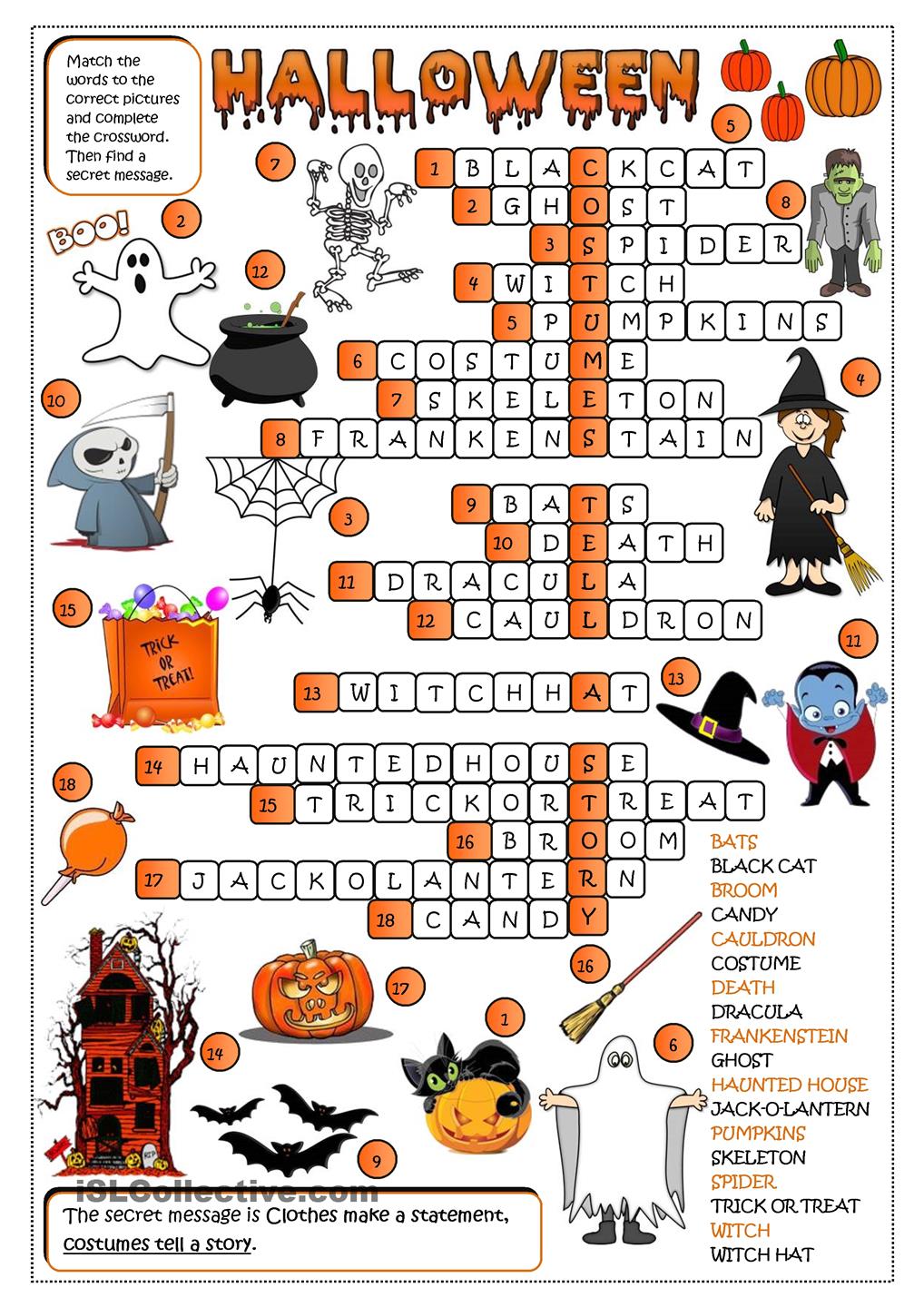
3. Crosswords
They are a great way to learn and review vocabulary. You can successfully use them to introduce new expressions. In some, you need to correctly match the clues to the pictures, and other times guess the clues.
Set 1
 |  |  |
Set 2
 |  |
Set 3

4. Stickers
Who doesn’t love stickers? You can use them for decoration or give them as a reward during lessons. We are sure they will be a fantastic addition! Remember to print them on adhesive paper.
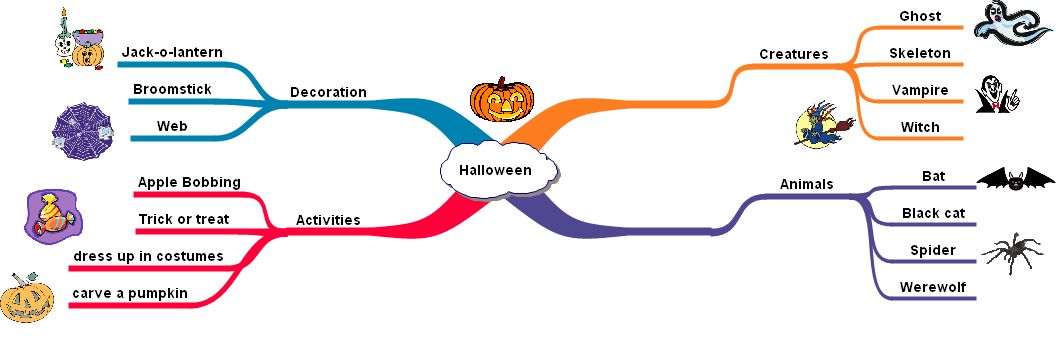
5. Associations
Here’s a fun activity for the beginning or end of a class to test knowledge. Write on the board or on a piece of paper (individually or in groups) in large letters, HALLOWEEN.
Create a mind map by listing associations with this custom or words that start exclusively with the letters from our word. If needed, you can encourage the use of dictionaries.
6. Lesson topics related to Halloween
If you’re considering which topic to discuss in a language class to make students eager and interested in conversation, here are some suggestions:
- Do You Believe In…? For instance, Do you believe in ghosts/spirits?
- Witches, Magic For example, Do you believe in magic powers?
- Characters Associated with Halloween Such as Dracula, Frankenstein, a witch, Harry Potter
An additional attraction could be defining forbidden words that cannot be used during the conversation. A fun idea is to motivate students with candies or stickers—for each forbidden word a student says, they give up one piece.
You can initiate the conversation by asking preliminary questions:
- A foreigner from a distant country asks what’s happening and why everyone is dressed up today. Describe what Halloween is.
- Describe a few ideas on what can be done on Halloween.
- Help a friend decorate an apartment for a Halloween party. What advice would you give?
7. Certificates
It’s worthwhile to appreciate your students’ efforts, so as a reward after the class, give them certificates. Choose a template and easily edit the students’ data. Create your certificate.
8. Halloween videos
Images capture our attention more than text, which is why it’s worth using even short videos in a language lesson.
From the videos below, students will learn about the origins of Halloween, the Celtic festival of Samhain, and how the tradition came to America.
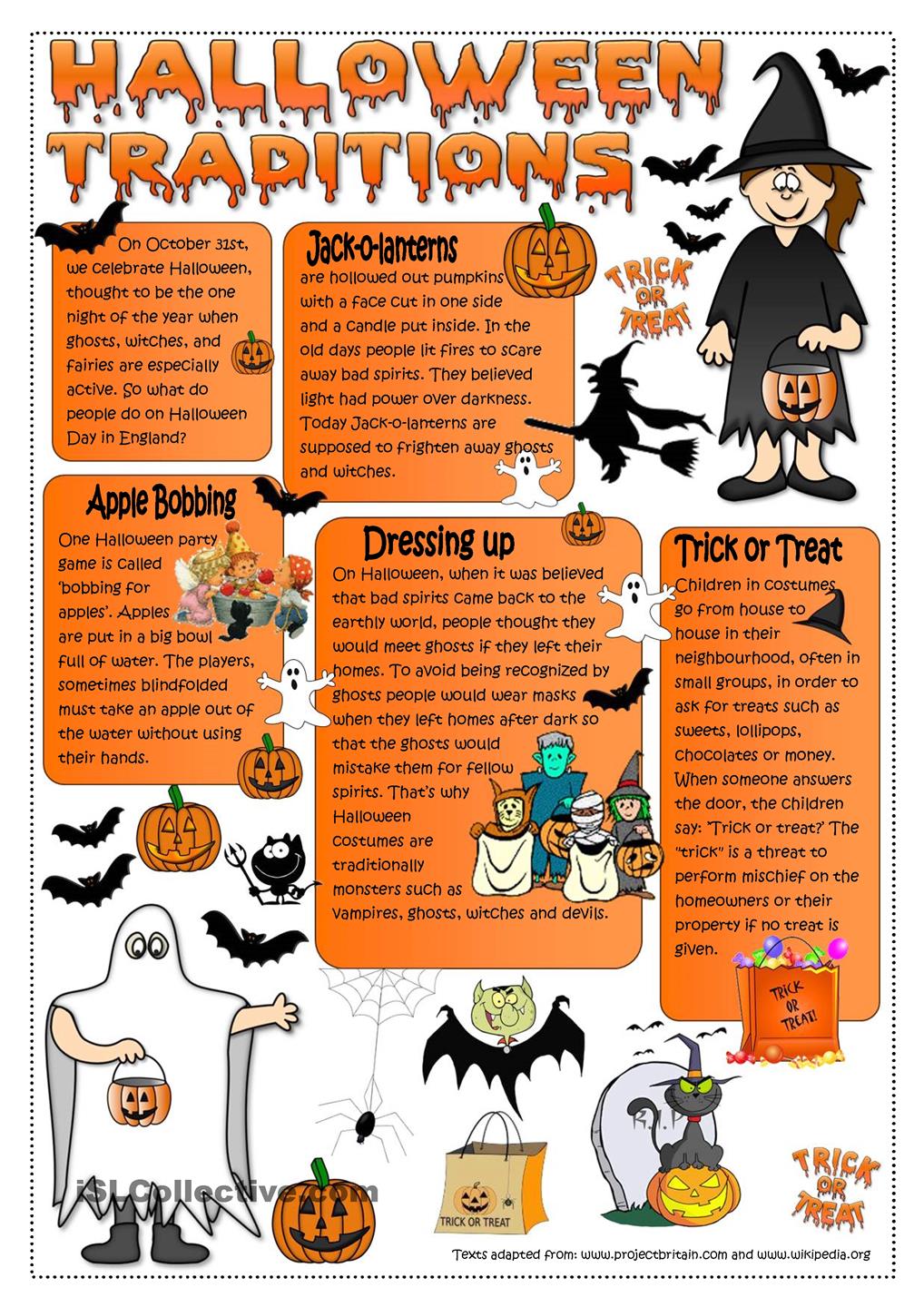
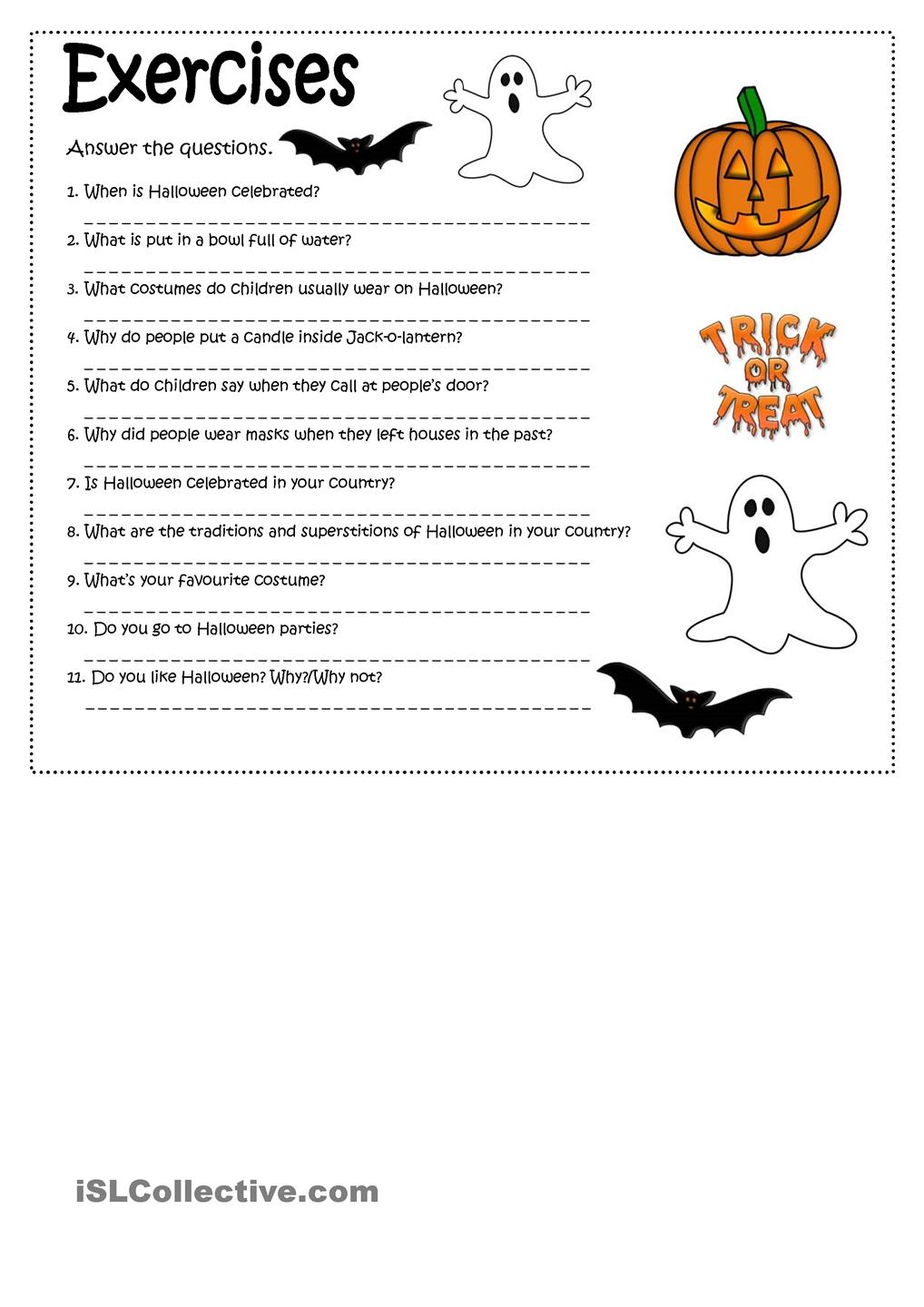
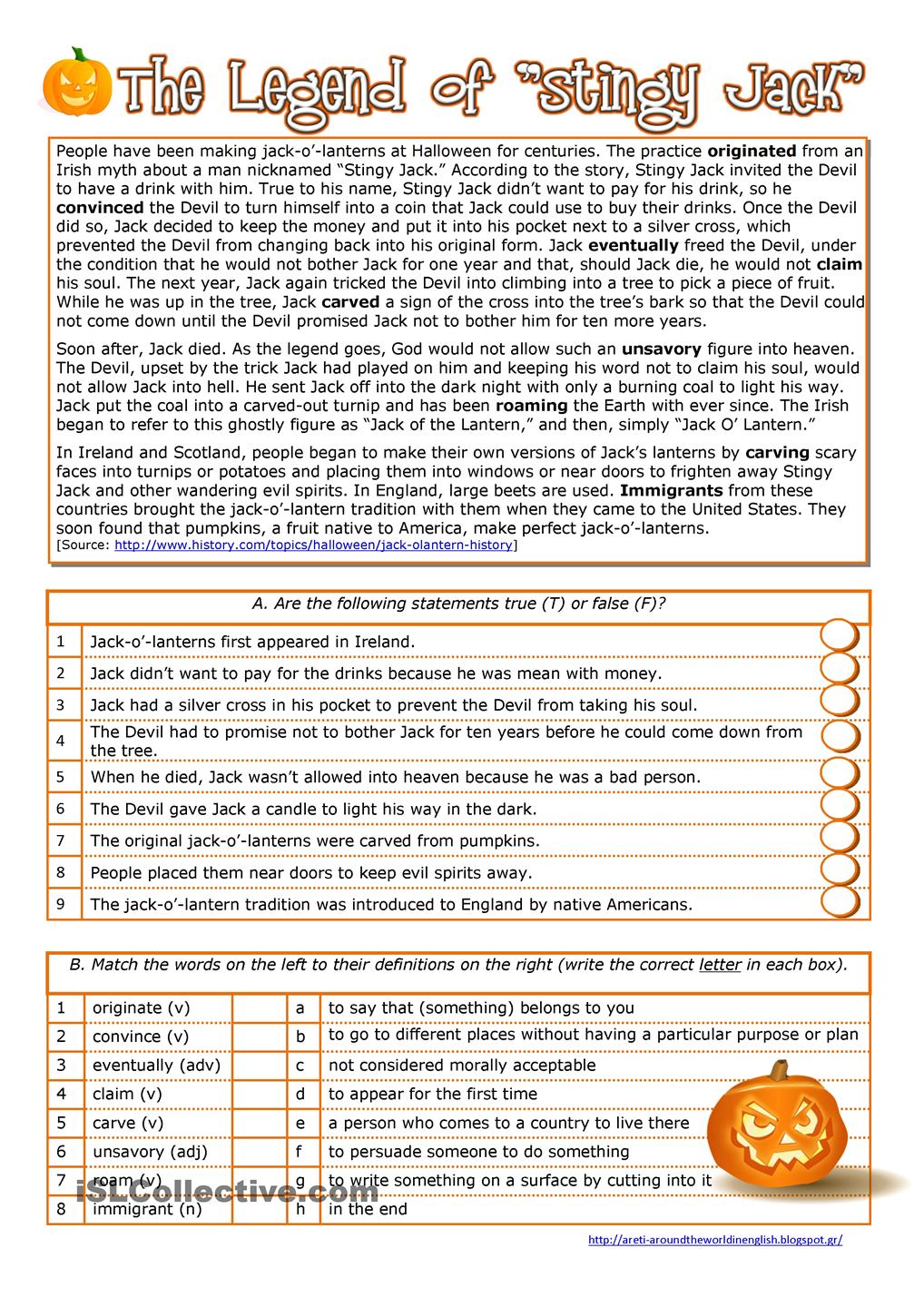
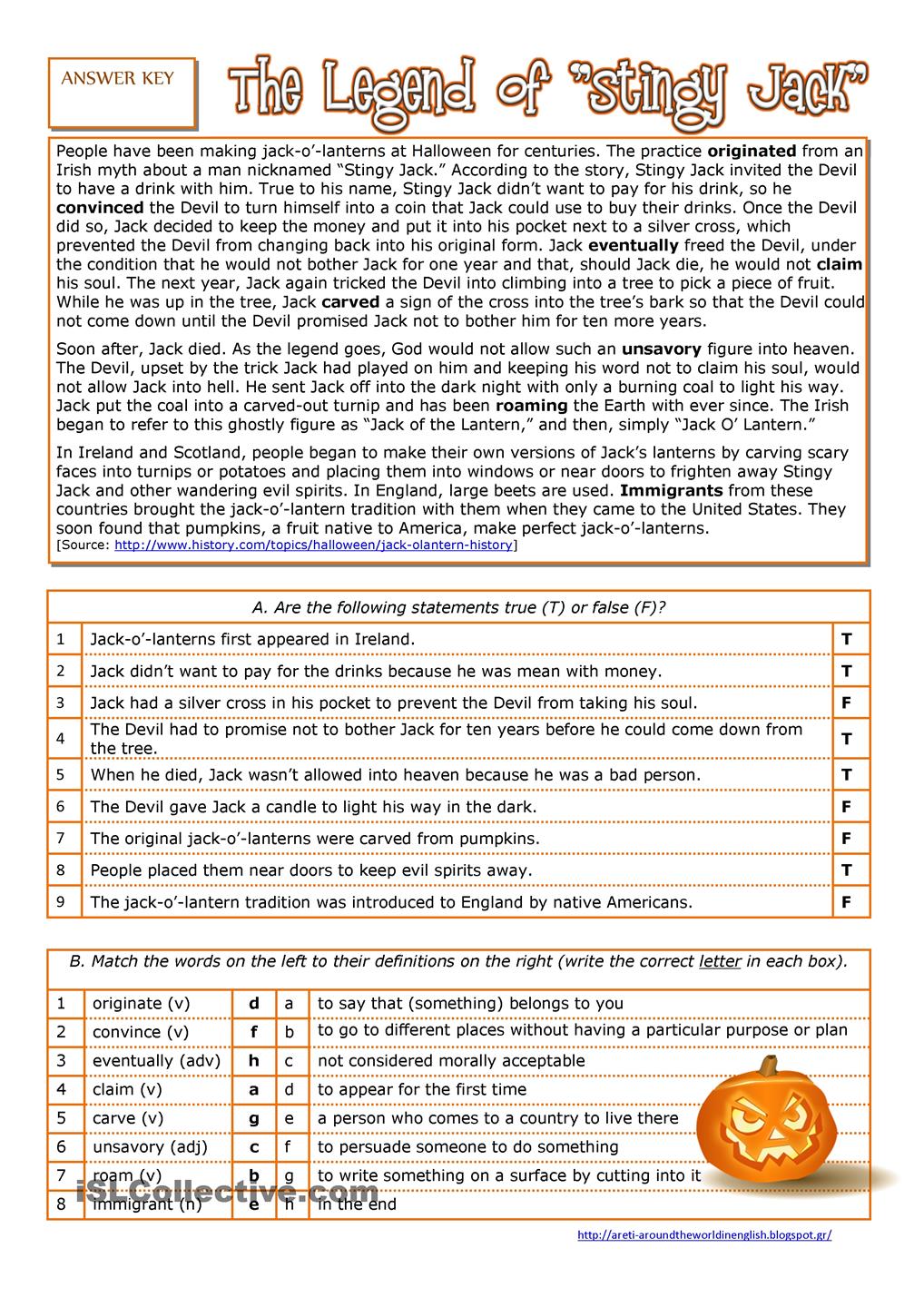
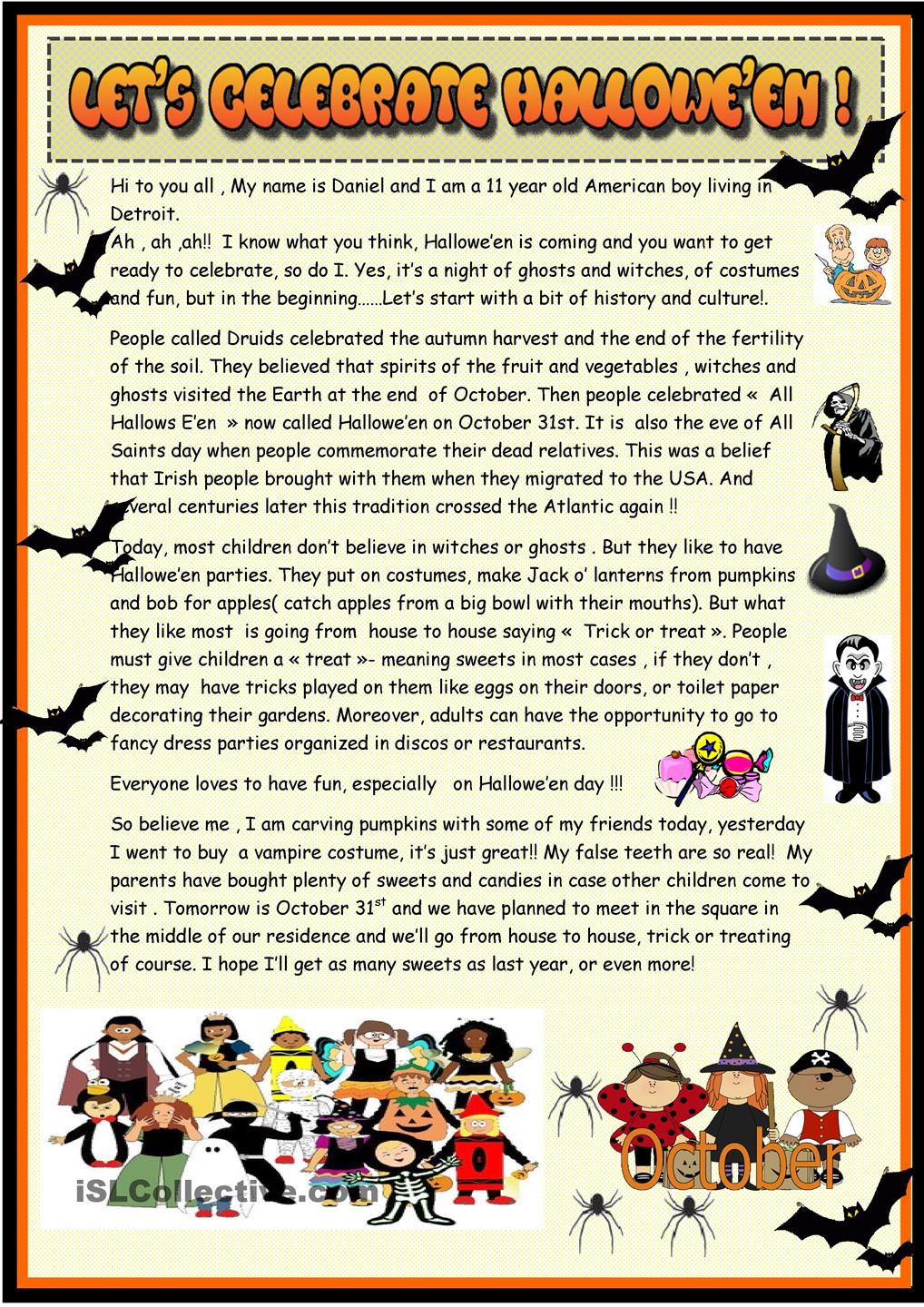
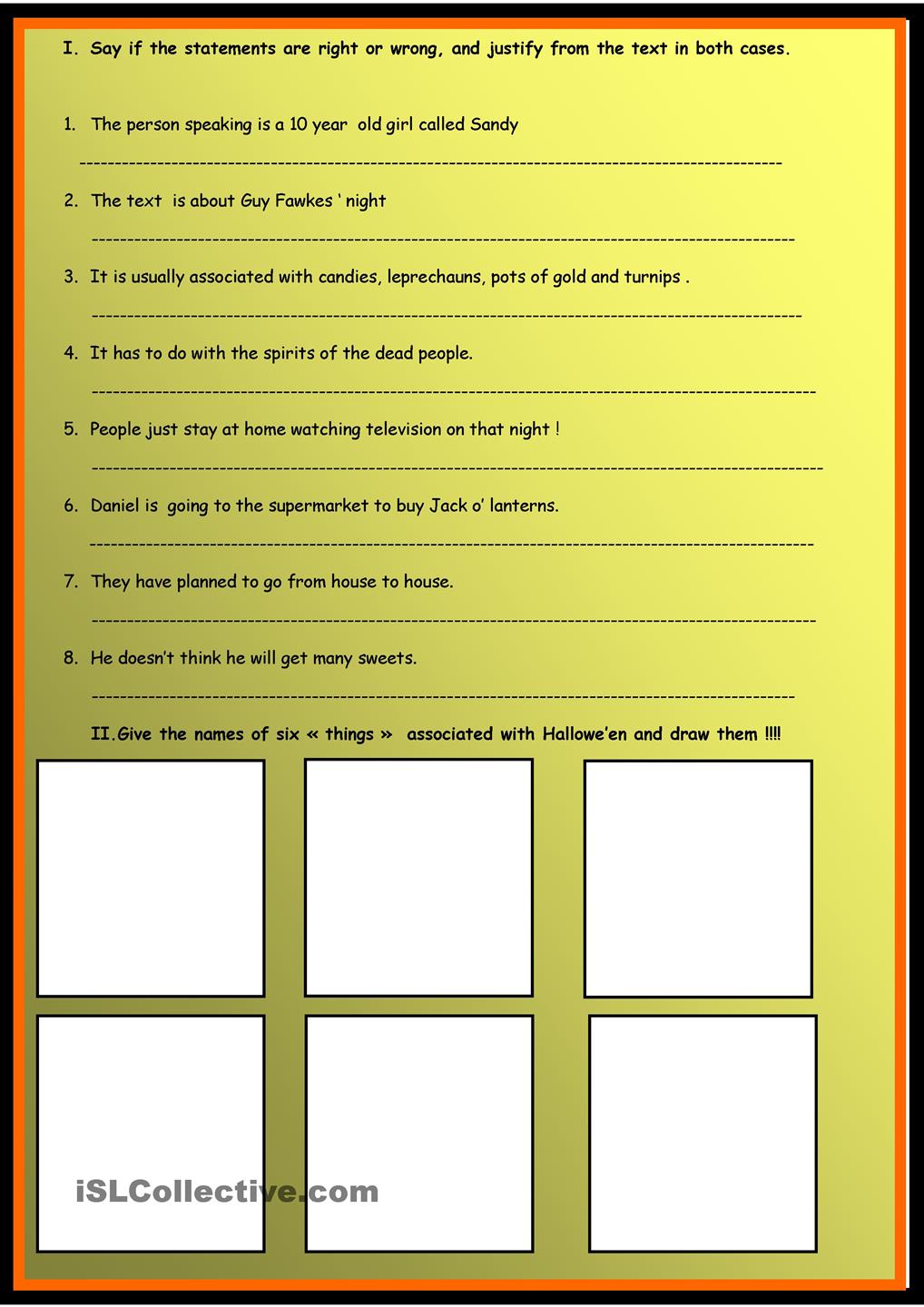
9. Reading passages
Utilize the texts below with ready-made questions and worksheets to develop reading and comprehension skills. As a standard practice, list unfamiliar words.
Set 1
 |  |
Set 2
 |  |
Set 3
 |  |
10. Generate Halloween materials on your own!
You can independently generate worksheets, tests, board games, crosswords, bingo, and other materials on the Tools for Educators website. This site offers tools that allow you to create unique Halloween-themed materials tailored to your students—by choosing the right illustrations, vocabulary categories, and task styles.
With the help of these generators, you can prepare engaging lessons that are consistent with the holiday theme while also expanding students’ vocabulary knowledge related to Halloween.
What does a ready 45-minute Halloween lesson plan look like?
The following plan is set for a group at the A2 level, children or teenagers. For lower levels, shorten the pair task, and for higher levels, replace the game with a conversation using forbidden words.
- Warm-up (5 min): association map with the word HALLOWEEN on the board.
- Vocabulary (10 min): 8–10 words from the table for A2 shown in pictures, followed by a crossword puzzle in pairs.
- Listening (10 min): a recording of What are you going to do for Halloween? and three questions related to the text.
- Speaking (15 min): a board game in groups of 3–4 people or a role-play „explain Halloween to a foreigner.”
- Closure (5 min): each person says one sentence about their plans for October 31st, and at the end, a certificate or a sticker is given.
This setup works because each part utilizes the vocabulary introduced earlier. The learner doesn’t receive ten independent activities, but rather one path from word to their own sentence.
How to use Halloween in a language school beyond the classroom?
For a language school owner, Halloween is more than just one fun lesson. Open lessons during the week of October 26-30 provide the school with contact with children who are not yet studying with you and their parents.
The simplest scheme looks like this:
- You announce an open lesson two weeks in advance, each student can invite one person, and you collect registrations through a form with the name, age, and contact information for the parent.
- A few days after the class, you contact the parents of the guests with a proposal for a trial lesson or information about available spots in groups.
The second effect is the content: photos of pumpkins with English captions, short videos from games, or costume collages are posts that parents share further.
Just remember to get consent for publishing images of children! If you want to make Halloween a bigger event with workshops or a costume contest, read about how to organize events in a language school that students will remember.
How to talk to parents about a Halloween lesson?
Halloween is not a neutral topic for everyone around the world. Some parents have reservations about this holiday, often due to its proximity to All Saints’ Day. It’s not worth ignoring or engaging in disputes. Just give notice and provide a choice.
In practice, send parents a short message a week before the lesson. Write what the lesson is about (vocabulary and customs of English-speaking countries), whether costumes are welcome, and that the child can come without a costume. If there are individuals in the group who do not want to participate, prepare an „autumn version”: the same vocabulary about nature, leaves, and pumpkins, without ghosts and witches. The lesson structure remains the same.
Sending such a message to several groups doesn’t have to mean copying emails. A language school management system like LangLion allows you to send SMS or email messages to selected groups.
For more on how to build a relationship with parents throughout the year, read the article on collaborating with parents in a language school.
Summary – English lesson for Halloween
Halloween in a language school works best as a planned thematic week rather than a one-time event. In 2026, this will be the week of October 26-30, as the holiday itself falls on a Saturday.
An English lesson for Halloween should have vocabulary suited to the level, two or three well-connected tasks, and one specific sentence that each student will say individually. For the school, it’s also an opportunity for an open lesson, content for social media, and contact with parents.
You can use the same class formats for other occasions, such as a Holiday language lesson in December or European Language Day in September.