
Continuing courses with existing students is one of the key elements for the stable growth of a language school.
Effective planning for continuation in schools means not waiting until the end of the semester but instead planning communication in advance, engaging teachers, showing students their progress, and making it easier for them to decide on another year of learning.
It is at this point that retention increases, and the school gains more peace of mind before the new season.
Key information
- Course continuation is one of the key pillars of the stable growth of a language school.
- The decision to continue is most strongly influenced by: a sense of progress, the relationship with the teacher, and the value of the course relative to its price.
- It’s beneficial to start continuation enrollments earlier, usually between March and May.
- Different age groups make decisions differently, so communication should be tailored to parents, teenagers, and adults.
- The teacher has a real impact on continuation because it’s with them that students build the closest relationship.
- A well-planned action schedule reduces chaos and makes it easier to plan groups for the new year.
- The communication path should be spread over time, not based on a single email sent just before the end of the course.
- It’s worthwhile to collect declarations earlier, as this gives the school greater predictability and organizational security.
- Technology can significantly simplify the continuation process if the school has tools for offering, enrolling, and signing documents online.
What will you find in this article?
- 3 main factors influencing the decision to continue
- How do different age groups decide on continuing courses?
- When do language schools conduct enrollment for continuation?
- Action plan schedule
- The role of the teacher in the continuation process
- Communication pathway before the semester ends
- How does the LangLion Platform support course continuation at a language school?
- Summary
3 main factors influencing the decision to continue
The first thing worth knowing is the psychology of decision-making, specifically the process of deciding to continue.
We can identify several factors that influence the decision to continue a course. Often, people mention factors like atmosphere, results, satisfaction, price, quality of teaching, methodology, the school’s brand… all of these are interconnected.
However, in my opinion, the most important ones are results, relationship with the teacher, and price.
1. Sense of progress
If a client does not see results, they will feel like they are standing still. Without a sense of progress, they will not have the motivation to continue the course. It is important to test, report progress, provide feedback to students, and ask them about their feelings – so they can realize they are making progress. This, in turn, increases the motivation to continue.
Learn more about this topic from our post: how to measure and improve customer satisfaction in a language school!
2. Relationship with the teacher
Students form stronger attachments to people rather than brands. Often, it’s the relationship with the teacher that determines whether they stay. If the teacher does not build a relationship, even the best price or offer will not suffice. The relationship with the teacher, as well as with the school as a whole, is crucial and can be decisive for the student’s decision.
Check out how to gain student loyalty in a language school!
3. Value for money
Price is an important factor, but it’s not just about having a low price. It’s about the value that the client receives for that price. Clients expect what they receive to be worth the cost. Even if a course is more expensive, if we deliver the promised results and the student sees this, they will be willing to pay more. The client wants to be sure that they made the right decision.
| What influences the decision? | What is worth doing in practice? |
|---|---|
| Sense of progress | Show results, test, give feedback |
| Relationship with the teacher | Strengthen the teacher’s contact with the group and the learner |
| Value for money | Communicate benefits, quality, and the value of the investment |
How do different age groups decide on continuing courses?
Parents
They are the largest market segment. They are rational, interested in their child’s development, opinions of other parents, safety, and predictability. Messages to them should emphasize professionalism, quality of teaching, results, and flexibility.
Teenagers
Here, the decision is made jointly with parents. Teenagers pay more attention to the atmosphere, relationships, and peer group. It’s worth talking about community, continuation with familiar people, and developing passions.
Adults
A pragmatic approach. Effectiveness, duration, price, class schedule, and what happens in the event of an absence are important. We need to be specific and clearly communicate details.
When do language schools conduct re-enrollment?
Most schools start re-enrollment between March and May. If we start too late, learners may have already made a decision—possibly encouraged by competition or friends.
It’s worth starting earlier because:
- we learn the number of learners sooner,
- we can better plan groups,
- we gain peace of mind during the holidays,
- the administration has less work „in a hurry.”
Schools that start early avoid chaos in August or September, when it’s difficult to maintain a high level of customer service quality.
Action schedule – course continuation in a language school
To ensure that the registration process for the next school year goes smoothly and effectively, it is essential to properly plan the actions over time. Below is a suggested action schedule that will help you plan the entire continuation process step by step.
90 days before classes end (March/April)
- Analysis of the situation, group occupancy.
- Decision on which groups will continue.
- Availability of teachers, classrooms, and resources.
- Internal communication.
60 days before (April)
- Preparation of the continuation offer.
- Discussions with teachers.
- First emails to students.
30 days before (May)
- Second wave of communication (emails, SMS, calls).
- Incentives, bonuses, early bird offers.
- Collecting declarations, preliminary group planning.
14 days before semester ends (End of May/June)
- Final reminders.
- Finalizing contracts and payments.
- Closing registration (set a specific deadline).
The role of the teacher in the continuation process
A teacher not only teaches – they have the closest contact with the students. Therefore, it’s worthwhile for them to know:
- when registrations begin,
- what the offer is,
- how they can inform the students.
Just one sentence from the teacher can make a student feel encouraged. However, the teacher needs to be prepared – don’t expect them to „sell” on their own. Provide them with specific messages, such as „we are continuing the group, there are two spots left,” or „I invite you to continue with me.”
Some schools offer teachers additional bonuses for continuation – for example, commission based on enrolled students or bonuses for high attendance in groups.
Such actions not only lead to greater engagement in the enrollment process but also help retain teachers at the school for a longer period, which in the long run translates into team stability and higher quality of teaching.
Communication pathway before the end of the semester
- 60 days before: first email – information about enrollments.
- 45 days before: SMS reminder.
- 30 days before: conversation with the teacher.
- 25 days before: second email – specific offer, bonuses.
- 20 days before: SMS – reminder, e.g., „5 spots left.”
- 10 days before: phone calls – finalization.
The entire process can be tailored to the specific needs of the school. It is important that students feel cared for and regularly informed. A sense of „time is running out” can effectively motivate them to make a decision.
How does the LangLion Platform support course continuation at a language school?
LangLion is a language school management platform, which allows you to effortlessly continue courses at your language school. Below, I present how it looks in practice.
Step-by-step course continuation in LangLion
In the Groups tab, you can easily carry out the course continuation process. To create a continuation group:
Step 1: In the General tab, click the Create Continuation Group button.
Step 2: The system will ask if you want to continue with the generator settings (keeping the existing days and times of classes). If so, the new group will automatically inherit these settings. You can also choose the option without generator settings and configure everything from scratch.
Step 3: After selecting the option, the form for creating a new group opens:
- you can change the group’s name (e.g., to English Group B1),
- change or retain the price,
- set the number of classes, grading system, and lesson unit length,
- specify the start date (the system will automatically calculate the end date),
- assign a textbook,
- set a limit on the number of students,
- choose a payment system (e.g., fixed monthly installments).
If the group is billed in an installment system, you can assign an appropriate payment template to it – the student, upon enrolling, will automatically receive an individual installment schedule.
You can also assign a ready document template to the group (e.g., a student agreement), which will be automatically filled with data from the system and can be signed online.
Step 4: After filling out the form, click Save and Close — the new continuation group is ready.
What does student enrollment look like?
Step 1: In the Secretariat → Students tab, you can select a specific student.
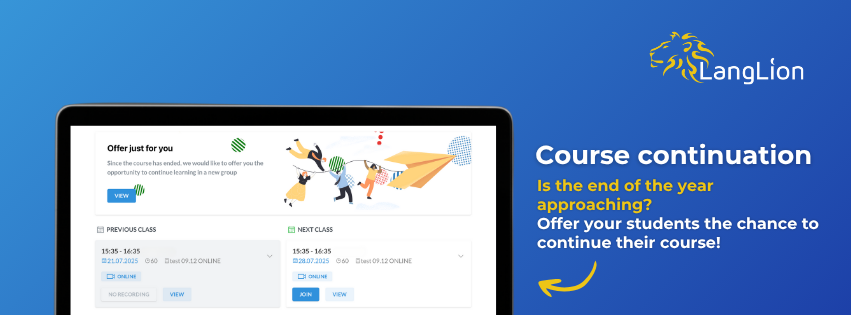
Step 2: In the student’s panel, when you assign them a special continuation offer, a message will appear: „Special Offer for You.”
Step 3: After clicking on the offer, the student sees the available groups (we can offer them several options, such as classes on Mondays or on Tuesdays and Thursdays).
The student selects a group and confirms enrollment:
- reviews the contract and payment terms,
- accepts and signs them online.
Step 4: Once the contract is signed, the student receives an email confirmation along with a copy of the document, and the secretariat is informed of the contract’s conclusion in the system.
Additionally, the student can immediately proceed to online payment (thanks to integration with payment operators, e.g., Tpay) and pay for the course via bank transfer or Blik. The payment is automatically registered in their account in the system.
Important notes regarding continuation in LangLion
- Children’s groups – often their final arrangement (days and times of classes) is determined only in September when public school schedules are known. In LangLion, we can create a group without assigned specific dates and fill them in later.
- Planned groups – the system allows for the creation of planned groups, but it’s worth remembering that they do not have the status of a continuation group and are not visible to the student. This is an organizational tool helpful for the secretariat in planning schedules.
- Offered students – students who have been assigned a continuation offer are visible in the Offered section. Only after signing the contract or paying for the course do they move to the Enrolled list.
- Reservations – Students who have expressed an interest in participating but have not signed a contract or paid for the course are placed in the Reservations section. We can set a time limit for them to confirm their participation.
- Pending – Individuals interested in a group who have not yet been assigned a spot are added to the Pending list. If enough of them gather, we can create a new group specifically for them.
Additional information
- Students can indicate if they wish to continue in another group or opt out of continuing. If they choose to opt out, they can also provide a reason, which provides the school with valuable feedback.
- If we have more class options to choose from (e.g., different schedules), we can offer them to the student in a single proposal — they will choose the option most convenient for them.
- The entire process is based on the LangLion Registration module — if you don’t conduct enrollments throughout the entire school year, you can activate the module only for the necessary period and then deactivate it to avoid additional costs.
Summary – course continuation at a language school
Effective planning for course continuation requires preparation and engagement from the entire team. Three elements are crucial: the student’s sense of progress, the relationship with the teacher, and the real value of the course relative to the price.
Communication planned well in advance, tailored to age groups, and a thoughtful schedule of activities involving teachers are also important. Regular reminders and incentives increase the chances of retaining students.
With a well-thought-out approach, we will not only increase the number of continuations but also build a stronger community of satisfied students.
If you want to learn how LangLion can improve the continuation of courses at your language school, book a free presentation of the LangLion Platform!