
In today’s world, effective customer relationship management is crucial for the success of any language school.
A CRM system in a language school plays a fundamental role in this process, enabling not only the organization of student data but also the automation of many processes and the improvement of communication.
Read on to discover the level of control over sales activities you can achieve by implementing a customer relationship management solution in your school.
What will you find in this article?
- What is CRM?
- How to choose a good CRM for a language school?
- Can Excel replace CRM?
- The CRM Module in LangLion
- CRM in a Language School – summary
What is CRM?
CRM stands for Customer Relationship Management. It is used for efficient management of customer contact to maximise the purchasing potential of acquired students and deliver the highest quality service.
Sounds very broad, doesn’t it? But it is within a CRM that data between marketing actions, sales activities, and their analysis and reporting should be connected.
The key question you, as the owner of a language school, should ask yourself is:
How many new contacts do I need to acquire to fill groups and achieve the planned financial result?
Without a CRM, unfortunately, it is difficult to answer such a question because you will need hard data for this – primarily the conversion rate (i.e., what percentage of new contacts become clients of your school).
If you do not have such data and rely solely on intuition, unfortunately, you may be mistaken. So, if you start measuring conversion, will the results improve?
Of course, it doesn’t work that way either – to change results, you have to change actions. However, having hard data makes it easier to determine whether action number 1 or number 2 was more effective.
Remember, the entire sales process does not end when a language course is purchased. The key to success is a regular client who, through their purchasing decisions, will influence the development of the school.
Maintaining good relationships and constant contact are therefore crucial for your school to enjoy a good reputation and gain recommendations from satisfied students. And here comes a range of tools to support this process.
How to choose a good CRM for a language school?
A good CRM in a language school should combine different types of activities in one place.
Starting with integration with mechanisms for acquiring new contacts – such as landing pages or registration forms, then moving on to conducting and controlling the sales process and supporting communication with potential and current clients.
In this one place, therefore, three areas are combined:
- Marketing – in the area of acquiring new clients,
- Sales – in the area of supporting the conduct of the sales process,
- Post-sales customer service – in the area of ensuring satisfaction and student satisfaction.
Thanks to combining them in one place, you gain data transparency and save time, as you don’t have to transfer or collect data from different places.
The choice of the right CRM system should be based on the specific needs of your institution.
Key features to consider
✔︎ Student database management: the ability to store detailed information about students, such as contact details, course history, payments, and grades.
✔︎ Source of contact acquisition: will allow you to analyse which contact acquisition channels are worth investing time and resources into.
✔︎ Notes from all conversations and proposals presented: regardless of who from your school’s staff the client speaks to, they must feel that their agreements are in effect.
✔︎ Client contact planning: each current student is simultaneously your potential client. Remember that they can purchase additional products, and quite soon, they may renew their course for another semester or year. If you wish to ask them about their opinion of the school before their next purchase, make a note of it as well.
✔︎ Sales process stage, also known as the sales funnel. This will allow you to analyse which stage of the sales process you are in and determine the time frame for its completion.
✔︎ Complaints and feedback: if you want to have complete information about the client, it is very helpful to record their complaints and feedback in one place.
Can Excel replace a CRM?
In a very basic version, Excel can replace a dedicated CRM tool, but it is not an ideal solution.
This happens for two main reasons:
- the human factor,
- functional limitations.
Human factor
When using any tool, the human factor matters, and any CRM without consistent management will be useless.
Nevertheless, in the case of working on a spreadsheet, this human factor is critically important. Your spreadsheet will not be integrated with the website or email, so all new data will need to be entered manually.
How many new contacts will your employees forget amid the clutter of tasks?
Functional limitations
The second issue is functional limitations. In a spreadsheet, it is very difficult to manage tasks to be completed and review the notes of other employees about a given client.
Often, amidst the flood of information, additional spreadsheets are created – one for schedules, one for payments, and one for CRM.
Thus, to find out anything, you have to switch between different spreadsheets, wasting time, ultimately affecting the quality of customer service (for example, when a client waits on the phone while you search for all the necessary information).
An integrated CRM tool will help you efficiently manage exemplary customer contact and maximise sales results. If you have already created a Customer Journey Map in a language school, then the CRM system will be an excellent tool to check whether the process you planned is being executed correctly and whether it delivers the best possible financial results.
CRM Module in LangLion
The CRM Module in LangLion has been designed to efficiently manage contacts with current, potential, and archived students.
It allows you to create notes, schedule, and record phone calls and meetings with clients, enabling maintaining organised and effective communication.
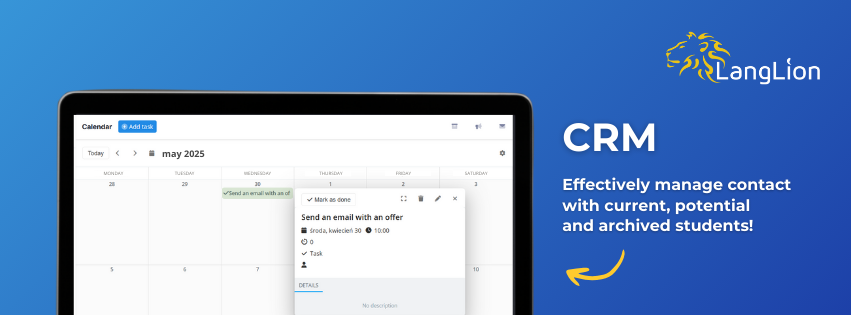
It is divided into three main tabs:
- Tasks: in this section, you have the ability to plan and monitor activities related to students, such as phone calls, meetings, or sending messages.
- People: this tab contains a list of all contacts, including active, new, and archived students.
- Calendar: allows you to view and edit all planned and completed tasks in a convenient and clear calendar format.
Thanks to the integration of the CRM module with other functions of the LangLion system, you can manage all aspects of communication and relationships with clients in one place, which will significantly streamline administrative processes in your language school.
CRM in a Language School – summary
Implementing an appropriate CRM system in a language school is an investment that brings tangible benefits in the form of better management, increased student satisfaction, and optimisation of operational processes. It’s worth taking the time to choose a tool that best fits the needs of your institution to fully enjoy its potential.
Unsure which language school management system will be best for you? 🧐
Managing enrolments, communication with students, payment control, CRM – all of this can be simple and intuitive if you choose the right tool. Schedule a free consultation, and we’ll show you how LangLion can support your school in everyday management.