
If your language school offers courses for businesses, you’re on the right track! More and more companies are investing in the language development of their employees.
The market for corporate language training is an extremely attractive segment for schools, but achieving success requires a different approach than with individual clients. Companies have specific expectations, decision-making processes, and criteria for evaluating the effectiveness of training.
Today, we will consider what to focus on when expanding your language school’s offerings to include corporate language courses.
What will you find in this article?
- Why do companies invest in language training?
- How do companies search for language training?
- How to leverage the potential of the B2B language training market?
- How does a business client differ from an individual client?
- What are the key elements of an effective business offer?
- Professional offer for business clients step-by-step
- Summary – language courses for businesses in 4 steps
Why do companies invest in language training?
In recent years, companies have become increasingly aware of the importance of foreign language proficiency among their employees.
Corporate language training is often viewed not only as an investment in the development of staff competencies but also as a component of building a competitive advantage and supporting international expansion.
In the context of globalization and international collaboration, knowledge of a foreign language becomes indispensable. Therefore, decision-makers in companies seek schools that offer high quality, transparency, and tangible results.
What do reports say about language courses for companies?
The results of international reports confirm that foreign language proficiency has a real impact on company development and their market position.
- The report „Making Languages Our Business” (ACTFL) indicates that managers and HR specialists increasingly view language skills as a key element of competitive advantage.
- Similar conclusions are presented in the EF Education First „What English Proficiency Means to a Business’ Bottom Line”, which shows that as many as 81% of companies would consider ending their partnership with a supply chain partner if their level of English proficiency was insufficient.
- Meanwhile, the EF „Business Impact” report highlights the internal aspect of employee development — 77% of companies admit that a high level of English proficiency facilitates promotions and career opportunities within the organization.
How do companies seek language training?
In this context, a business client operates differently from an individual client. This is often a person from the HR or L&D (Learning & Development) department, who applies service evaluation criteria similar to those in consumer life.
It’s important to remember that the majority of consumers (according to various sources, about 50-60%) conduct online research before purchasing a product or service, such as comparing offers and reading reviews (PwC, Global Consumer Insights Pulse Survey).
This mechanism also operates in the B2B relationship, where the person deciding on the choice of a language school for the company searches the Internet.
Read the article and find out why a business client chooses a particular language school!
How to leverage the potential of the B2B language training market?
Language courses for companies are a market segment that can provide a language school with stable and long-term revenue. Companies invest in the development of their employees, making language courses a key element of training programs.
As shown by the analysis of the language school market, this industry is dynamically changing, requiring schools to be flexible and adapt their offerings to different groups of clients – including companies.
However, to effectively acquire business clients, the offer of courses for companies must be well thought-out, flexible, and tailored to their needs.
How does a business client differ from an individual client?
The starting point for creating an effective offer is understanding how a business client differs from an individual client. What to pay attention to?
1. Multilevel decision-making process
In the case of companies, we rarely deal with a single decision-maker. Usually, the process involves:
- the HR or training department,
- supervisors of departments whose employees are to participate in the training,
- the finance or purchasing department – evaluating the cost aspect,
- management – ultimately approving larger training budgets.
Practical example: ABC Language School prepares three versions of materials for each corporate offer: a detailed substantive description for the HR department, a summary of business benefits for management, and a clear cost analysis for the finance department.
2. Focus on measurable results
Companies expect tangible effects from their investment in language training. Simply having „pleasant classes” is by far not enough – concrete business results are key.
Practical example: ABC Language School includes a „Measurable Effects” section in each corporate offer, specifying what concrete skills (e.g., the ability to conduct teleconferences in English fluently) employees will acquire after a specified number of training hours.
3. Specific language needs
Companies typically are not interested in general language learning but in developing language competencies in specific areas related to their activities.
They most often reject the universal model of courses for companies and seek something that can provide their employees with a personalized learning system.
The most common needs of companies are:
- entering a new market,
- the need for comprehensive improvement of employees’ language skills,
- improving relations with international clients and collaborators,
- learning language specific to a given industry,
- training as a benefit for employees.
Regardless of the intention, it is worth showing that you address the specific needs of your potential clients.
Practical example: ABC School, when preparing an offer for a company in the logistics sector, included a special module dedicated to vocabulary concerning the supply chain, transport documentation, and handling complaints in German.
Corporate language courses – what are the key elements of an effective business offer?
Step 1. Needs analysis as the foundation for successful collaboration
Not every company has the same language needs. It’s worthwhile to start collaboration with a client expectations analysis and defining the key objectives of the course.
Such an analysis should include:
- the current level of employees’ language competencies;
- specific professional situations in which employees use a foreign language;
- specific competency gaps felt by employees and their supervisors;
- business goals that the company wants to achieve through language training.
Practical example: Before preparing an offer, ABC language school conducts a free needs assessment that includes: a short online test for all potential participants, a survey regarding professional situations requiring language knowledge, and an interview with supervisors about expected business outcomes. Based on this, a tailored collaboration proposal is prepared.
Step 2. Flexible training format
Individual meetings or online training? The pandemic has significantly influenced the change in work style in many companies.
Most of them have transitioned to remote or hybrid work. This will also affect the method of teaching in the case of language courses.
The convenience and effectiveness of online learning seem to still dominate in this case. However, there are also companies that opt for courses at the school’s facility or the company’s headquarters.
Corporate courses need to consider the specificity of work and the time constraints of participants.
What can you offer?
- Individual training. This type of learning is suitable, for example, For employees with tight schedules or frequent business trips, individual courses, especially those conducted online, allow for adaptation to even the busiest individuals. Flexible sessions are also useful for providing immediate language support, for example, when an employee has an important business meeting with a foreign client the following week.
- Group classes (in-person or online). This teaching model is best suited for groups/teams of employees who want to acquire the same language skills.
To meet the expectations of your potential client, you can also offer:
- access to an e-learning platform with assignments tailored to the client’s industry,
- the possibility to reschedule classes due to unforeseen professional obligations.
Step 3. Determining the Return on Investment (ROI)
For a company, it is very important to measure the return on investment in language learning (ROI).
The results of employees will influence:
- better relationships with international clients and colleagues,
- higher motivation and engagement,
- improved communication,
- greater cultural awareness,
- entry into new markets,
- overall effectiveness in task execution.
In your offer, include the preparation of reports that will contain the progress of participants, the effectiveness of the course, and the return on investment (ROI).
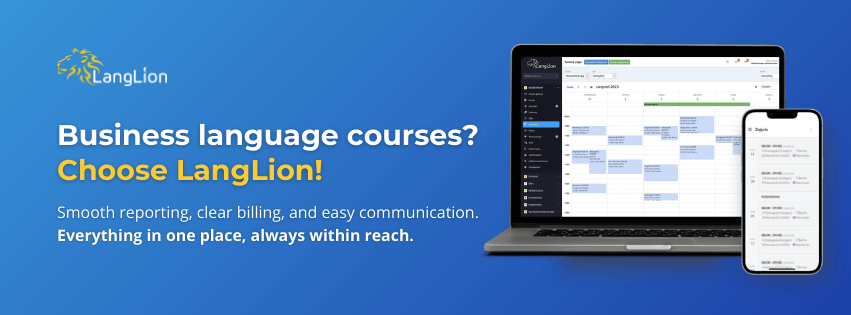
A very useful tool in this case would be, for example, the LangLion e-gradebook with a dedicated participant panel, grading system, attendance, and reports.
Test LangLion for free for 14 days and see how to utilize its functionalities in conducting courses for companies!
Step 4. Reporting and monitoring progress
Companies expect regular updates on employee progress and training effectiveness.
In reporting, it’s worth including:
- employee attendance,
- implementation of the teaching program,
- results of interim tests,
- recommendations for further training actions,
- an online dashboard with the ability to view progress.
Professional offer for business clients step-by-step
A well-prepared offer for a company should have a clear structure and present the benefits of the course.
Let’s take a look at the elements worth including.
- Course description – a concise summary of the entire offer, containing key elements and business benefits. This is often the only part read by management.
- Initial situation analysis – conclusions from the conducted needs analysis, showing understanding of the client’s specifics and employees’ language challenges.
- Training goals – specific, measurable objectives that will be achieved through the training.
- Training program – a detailed description of the program divided into modules and indicating how they address the identified needs.
- Schedule of classes – including flexible time options, frequency of classes, location, and group size.
- Teaching methodology and tools used
- Monitoring and reporting system
- References – examples of similar projects completed for other clients in the same industry.
- Cost estimate and terms of cooperation – clear financial terms and possible discounts for regular clients.
Summary – language courses for businesses in 4 steps
Securing a corporate client is just the beginning. The goal should be to build a long-term collaboration that benefits both parties.
What can you do to maintain such a relationship?
- Propose regular evaluation meetings – organize quarterly meetings with the HR department and participants’ supervisors to discuss progress and adjust the program.
- Conduct satisfaction surveys – regularly collect feedback from participants and implement improvements. Learn more about enhancing student satisfaction in a language school.
- Report results more regularly – demonstrate the business value of completed trainings (e.g., specific business situations where employees used new language skills).
- Focus on cross-selling – once trust is established, propose expanding collaboration to new departments or additional services.
Companies are willing to pay more for training that brings real business benefits. Therefore, it is worth investing time in preparing a personalized, tailored offer that will distinguish your language school from the competition, which mainly focuses on individual clients.
Remember that a business client, although more demanding in the initial phase, can become a source of stable, long-term revenue and references, which will be the foundation for the development of your language school.
Do you want to expand your language school’s offerings to include language courses for companies? Find out how LangLion can help you with that!